
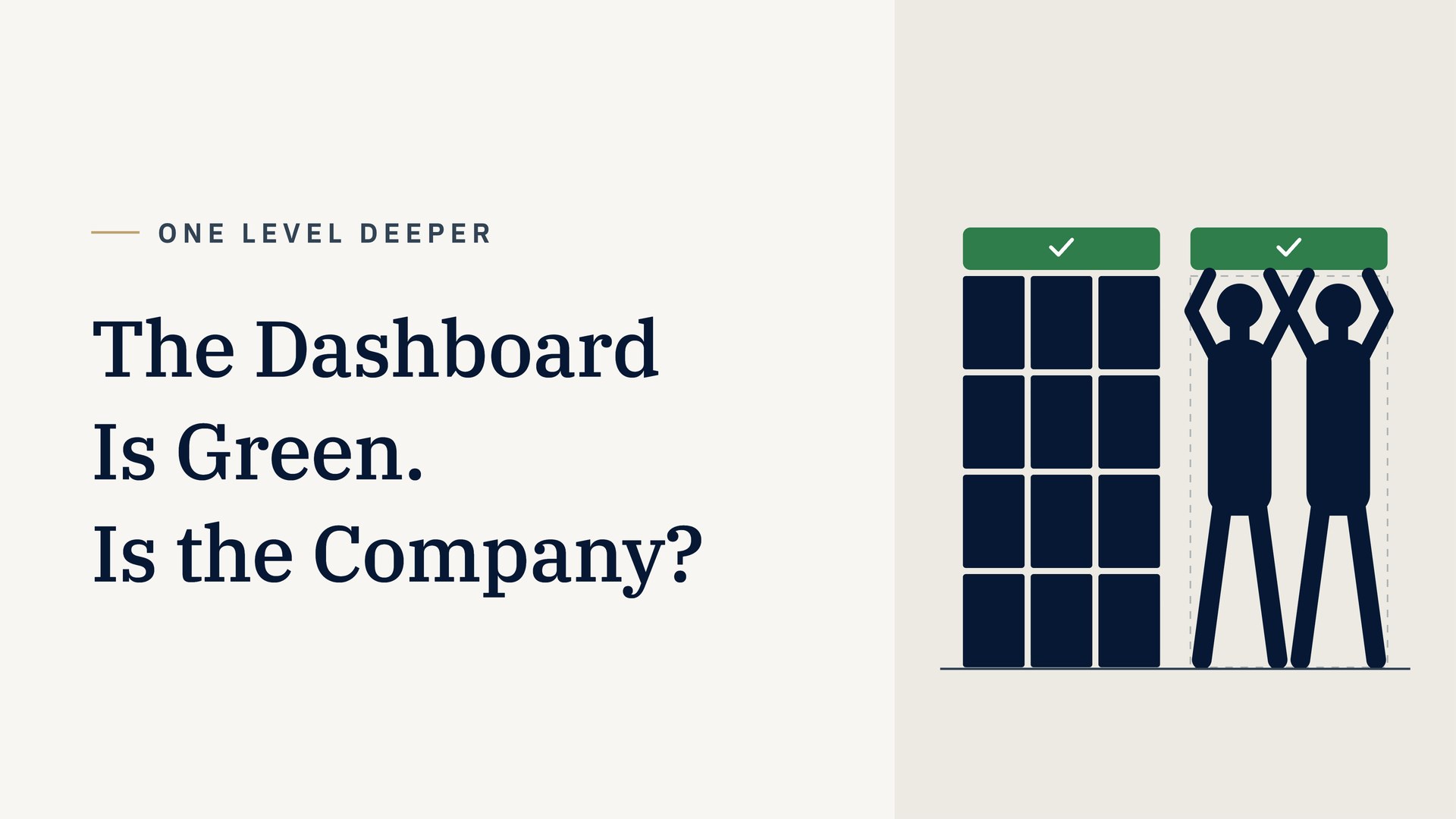
A company can deliver excellent financial results while becoming less capable of delivering them again.
Revenue grows. Profitability improves. Customers keep buying. The dashboard is green. By conventional business measures, the company is doing well.
But what exactly do these numbers tell us?
Business KPIs deserve close attention. Revenue can grow while profits shrink. A company can look profitable on paper and still struggle to pay its bills. Changes in margins, cash flow, or customer retention can be early signs of trouble.
But even good numbers don’t tell us everything.
The same financial results can hide very different organizational realities.
Consider two companies reporting similar profits.
In one, results come from reliable processes, capabilities spread across the company, and coordinated efforts. Work gets done without someone constantly stepping in. Problems are resolved, customers receive what they were promised, and business continues when key people are away.
In the other, the same results depend on a few indispensable individuals, exceptional effort, or favorable circumstances. People work late, repeatedly fix mistakes, and a handful of experienced employees step in whenever something goes wrong.
Both may look equally successful in their financial reports. But their ability to keep it up, cope with a shock, and grow without wearing the organization down may be very different.
What happens when demand increases, an important employee leaves, or the market gets tougher?
Business KPIs: What results are we achieving?
So, the two companies report similar profits. Do they have equally good reasons to be pleased with the year?
Sales are up. Where did the growth come from? Perhaps more customers bought from us this year. Perhaps we raised prices. Perhaps a few large orders made up for customers who quietly left.
Revenue tells us how much we sold. Customer acquisition and retention tell us whether we win new customers and keep existing ones. Profitability tells us how much we earn on those sales. Cash flow shows when money actually comes in and goes out.
Read together, those figures can change our view of the year. Growing sales look more encouraging when customers are staying, margins are holding, and the cash is coming in.
That gives us good reason to call it a strong year. But could the business handle another year of growth? A profit margin shows what we earned on the orders we delivered. How much work it took to get those orders out the door is a different question.
Operational performance: What does it take to produce those results?
Two companies can generate the same revenue and profit. But the way they get there can be remarkably different.
In one, work moves smoothly. People know what needs to happen, problems get resolved, and customers receive what they were promised.
In the other, deadlines are constantly rescued at the last minute. Mistakes need fixing, people chase information, and getting things done takes far more effort than it should.
The difference becomes visible when we look at how work actually gets done. How long does it take? How often must something be corrected? How much time is lost waiting for decisions, information, or other people? What happens when the workload increases?
These are the questions behind the KPIs of productivity, quality, speed, and delivery reliability.
Two companies may earn the same profit. One has a way of working that makes it repeatable. The other has to fight for it every day.
But even knowing where work slows, stalls, or becomes unnecessarily difficult doesn’t fully have explaination why.
Why can some teams handle problems independently while others struggle with routine decisions? Why does the same process work well in one department but poorly in another?
The answers are not always found in the processes themselves. They often lie in what people are capable of doing together.
Organizational capabilities: What makes people and teams effective?
A process can be perfectly designed on paper and still fail in practice.
Give two teams the same task, the same resources, and the same procedures. One will find a way to deliver. The other will get stuck as soon as something unexpected happens.
What’s the difference?
It may be the ability to make sound decisions without constantly seeking approval. To recognize a problem before it becomes a crisis. To combine different perspectives, challenge assumptions, and find solutions that nobody had anticipated.
Or simply the ability to work together when the situation doesn’t fit the instructions.
How early do teams spot a problem, and how much can they resolve before they need to escalate it? If the problem cuts across departments, can the managers involved agree on what needs to happen and coordinate the work?
These capabilities stay invisible most of the time. We notice them when something goes wrong or when circumstances change and familiar routines no longer work.
A team that delivers because one experienced person knows every workaround is very different from a team where knowledge is shared, people can exercise judgment, and others can take over when necessary.
Both teams may meet their targets today. But remove that one experienced person, introduce a new product, or double the workload, and the difference becomes obvious.
Organizational capabilities determine not only what a company can deliver under familiar conditions, but also what it can handle when those conditions change.
Why do some organizations develop these capabilities while others remain dependent on a handful of capable individuals?
Management system: What shapes those capabilities?
Two companies can hire similar people from the same labor market at similar salaries and still end up with very different capabilities. The difference lies in what the management system allows people to do, and what it expects of them.
Where are decisions made, and who may make them? How do priorities and resources turn into action? Who answers for what happens between departments? What happens when results miss the target? And does what the company learns change its next decisions?
In the company that depends on a handful of people, every difficult case ends up with the same few. Important decisions wait for their approval. Problems between departments land on their desk, since they belong to no one else. And once every missed result starts a search for the guilty, nobody else volunteers. Each of these is a management choice, and each seemed reasonable when it was made.
Those few get all the practice. Everyone else gets instructions. Why build your own judgment when every important decision is made by someone else? Why raise a problem early when the first question will be who caused it? Improvement waits, because the same few people are busy with urgent work. And the lessons stay with them.
Results come to depend on a few people. What everyone else is capable of never shows up in the numbers.
As long as results are good, nothing signals a need to change. Individual effort covers the gaps, and the dashboard stays green.
Good results keep the system unchanged. An unchanged system keeps sending every difficult case to the same few. And each year, the company depends on them a little more.
Adding KPIs rarely fixes problems that keep coming back. A new KPI enters the same management system: the same people deciding, the same review, the same reaction when it turns red. Soon it is managed as skillfully as the old ones.
From results to management: Where does the problem start?
The management system decides what people get to practice. What they practice becomes the organization’s capabilities. Capabilities decide how work gets done. And the way work gets done produces the numbers on the dashboard.
The chain also runs the other way. Results shape how a company is managed, which is why good results can keep a weak system in place for years.
Results, operations, capabilities, and management each need their own evidence. Revenue growth says nothing about how decisions are made. And business KPIs describe a year that is already over, while capabilities decide what the next one can bring.
So when the KPIs disappoint, the question is where the problem starts. In how work is organized? In what people and teams are able to do? Or in the management system that shapes both?
And when the KPIs look excellent, the question is less comfortable. How much of the result comes from the organization, and how much from a few people who keep stepping in?
One Level Deeper is my weekly newsletter on systems thinking in management.
Subscribe to One Level Deeper → Follow me on LinkedIn →